In pallet handling, the right conveyor choice depends on more than moving a load from point A to point B. The load type, pallet condition, operating environment, transfer direction, and system layout all matter. For Alba Manufacturing applications, three common solutions are
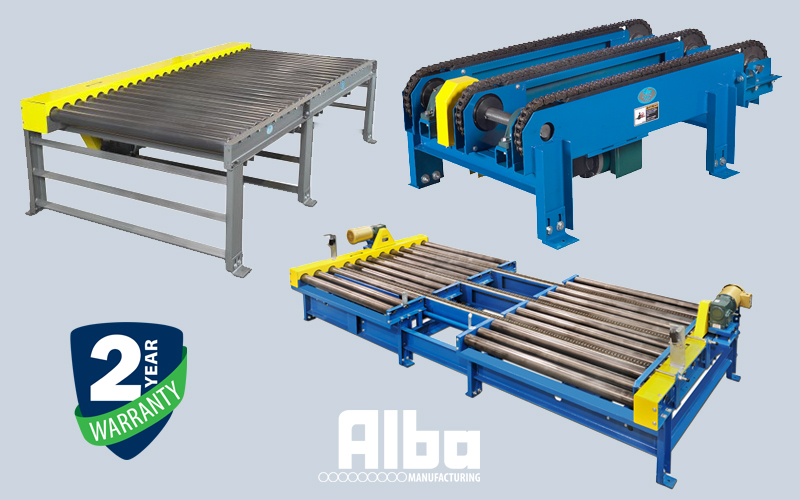
Chain Driven Live Roller (CDLR) Conveyors, Drag Chain Conveyors, and Chain Transfer Systems. Each has a clear role, and choosing the right one upfront helps reduce downtime, improve flow, and avoid costly rework.
Chain Driven Live Roller Conveyor: Best for Controlled Pallet Movement
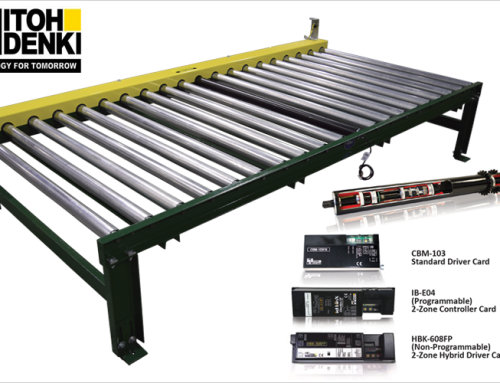
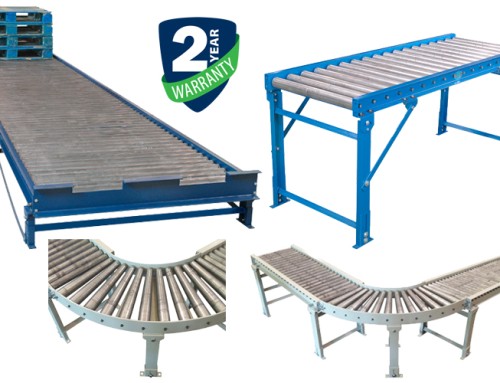
A Chain Driven Live Roller Conveyor, or CDLR, is often the backbone of a pallet handling system. Alba’s CDLR conveyors are available with roller diameters including 1.9″, 2-1/2″, 2-9/16″, and 3-1/2″ or larger, depending on the application. Standard sections are commonly available in 5-foot and 10-foot nominal lengths, with typical speeds of 30, 45, or 60 FPM. Alba’s conveyors are shipped fully assembled and tested before shipment.
CDLR conveyors excel when pallets, containers, or loads have a bottom surface that can ride smoothly across rollers.
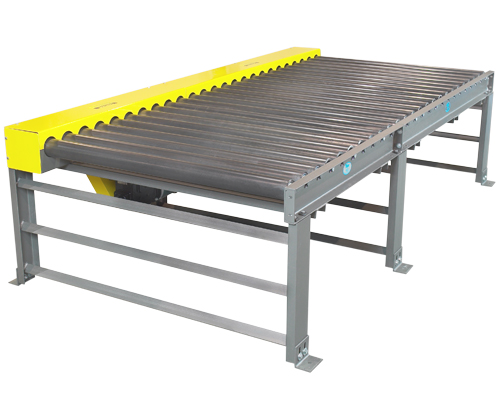
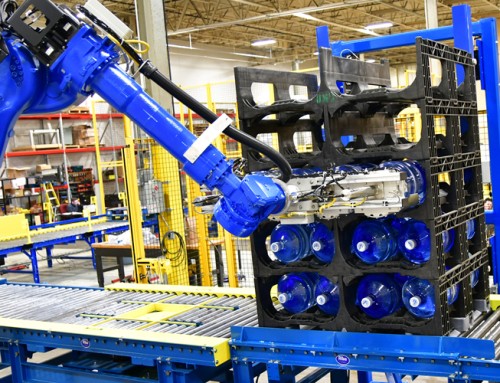
They are a strong choice for straight-line pallet transport, accumulation zones, palletizing lines, stretch wrapping lines, and integrated conveyor systems.
For lighter to medium-duty applications, Alba’s 1.9″ CDLR is suited for conditions where dirt and oil may be present. For heavier pallet loads, we recommend the 2-9/16″ CDLR as a heavier-duty option and an ideal choice for carrying heavy pallet loads.
Where CDLR Works Best
CDLR is best when the pallet bottom is compatible with rollers, the system needs controlled transportation, and the application calls for reliable movement through production, palletizing, wrapping, or warehouse operations.
Drag Chain Conveyor: Best for Loads That Do Not Ride Well on Rollers
A Drag Chain Conveyor is the better choice when the load does not convey well on rollers.
Alba’s standard drag chain conveyors are used to move products and pallets in manufacturing and warehousing environments, especially when the product will not convey properly on roller conveyor. Our standard drag chain conveyor can handle up to 4,000 lb.
This makes drag chain conveyors useful for pallet types or load conditions where roller contact is not ideal.
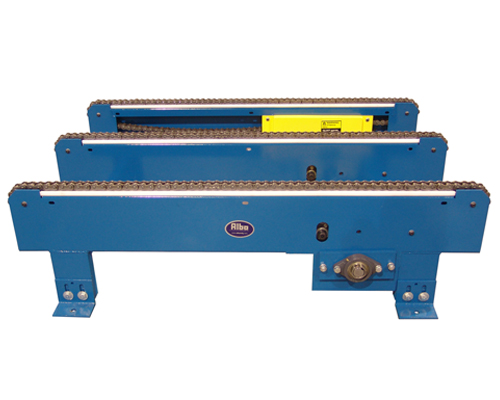
They are often a practical solution for bottom-board orientation issues, uneven pallet conditions, skids, or applications requiring chain support under the load.
Drag chain conveyors also fit well in heavy-duty industrial layouts where durability matters. Drag chain conveyors are a critical part of many system installations, built around strength and reliability in pallet handling and heavy-duty material flow.
Where Drag Chain Works Best
Drag Chain is best when pallets or products are difficult to move on rollers, when positive chain contact is needed, or when the application requires rugged conveying in a demanding manufacturing or warehousing environment.
Chain Transfer Systems: Best for 90-Degree Movement and Layout Flexibility
A Chain Transfer System is not usually the main conveyor line. Its job is to transfer loads from one conveyor path to another, often at a 90-degree angle. This is where chain transfers become critical in system design.
Alba provides standard chain transfers including In-Frame, Thru-Frame, Frame-to-Frame, and Thru-Drive-Side types. All of our standard chain transfers have load capacities up to 4,000 lb.
Alba’s Frame-to-Frame chain transfer is designed with transfer chains mounted within the effective width of two parallel CDLR conveyor frames.
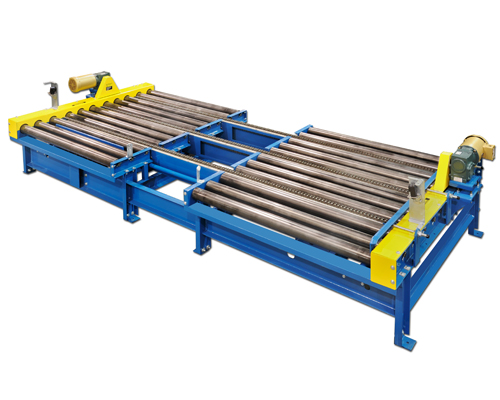
This configuration as ideal for transferring containers and palletized products at 90-degree angles, with maximum capacity up to 4,000 lb.
Chain Transfers are especially useful when the layout needs to change direction, merge lines, divert pallets, feed palletizers, connect to stretch wrappers, or move product between parallel conveyor runs. They help make the system work as a complete layout, not just as individual conveyor sections.
Where Chain Transfers Work Best
Chain Transfers are best when pallets need to change direction, move between conveyor lanes, or integrate with other equipment in a controlled system layout.
The Practical Takeaway
A CDLR Conveyor may handle the main transport path. A Drag Chain Conveyor may solve a pallet support or orientation challenge. A Chain Transfer may move the pallet at a right angle into the next process. In a properly engineered system, each conveyor type does the job it was built to do.
That is where Alba Manufacturing’s experience makes the difference. The right solution starts with the application: pallet size, load weight, bottom-board condition, environment, speed, transfer points, and the equipment being integrated before and after the conveyor.
Get those details right, and the conveyor system is more likely to run smoothly, hold up over time, and support production without becoming a maintenance headache.
If you have a pallet handling challenge, contact Alba Manufacturing today to discuss the right conveyor solution for your application.